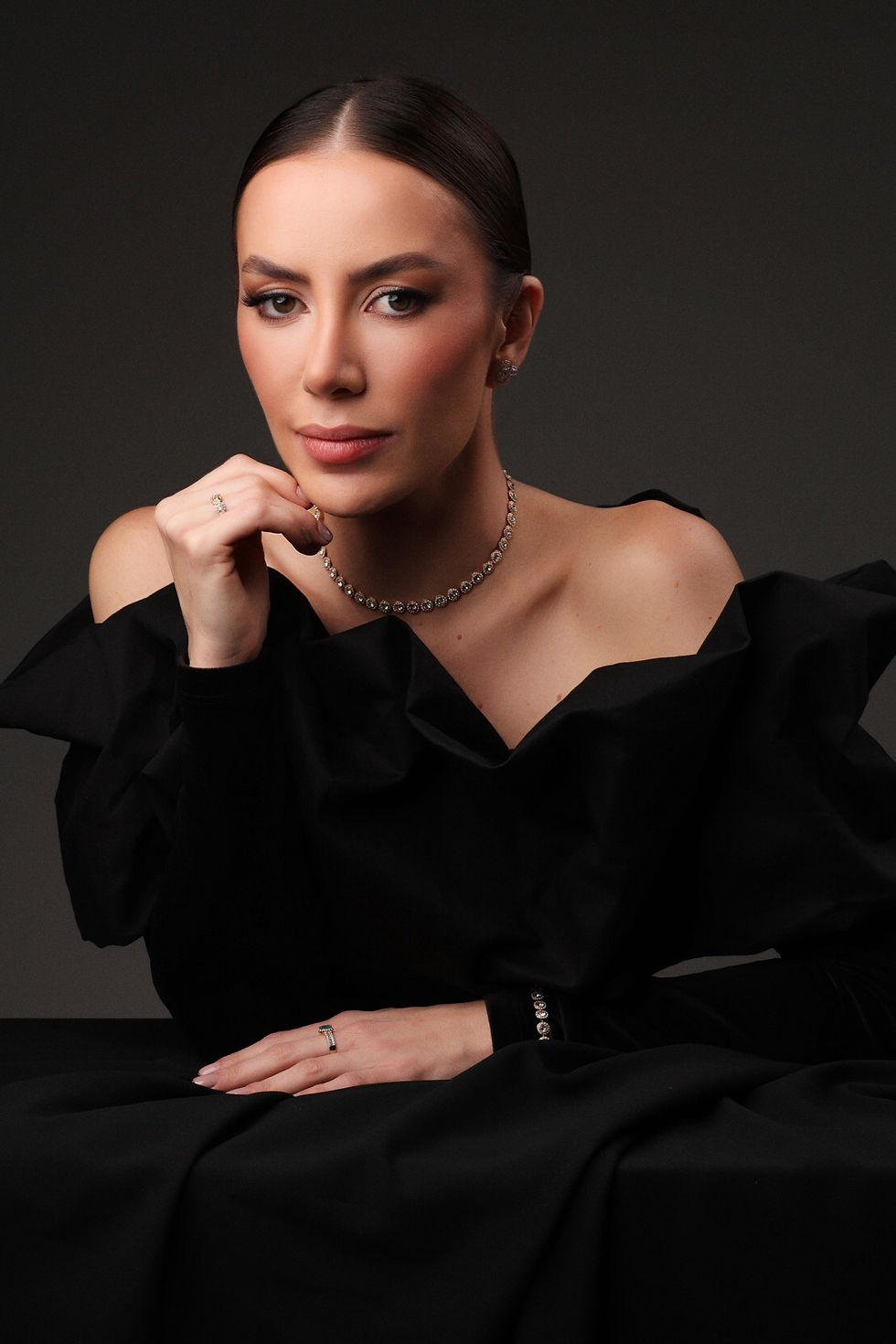
Bianca Zuber: The face as identity, aesthetics as awareness

Updated: Dec 23, 2025
“BEAUTY” COVER EDITION - DECEMBER 2025 ISSUE

Bianca Zuber did not build her career on haste or trends. Graduating in Dentistry in 2013, she began her professional path through the most traditional route of the field, where technique, precision, and predictability usually set the pace. Even so, from the very beginning, her perspective went beyond functionality. It was not only teeth that drew her attention, but the face as a whole and what it communicates even before a single word is spoken.
Facial aesthetics was always present as a form of language. In 2014, when she completed her first course in the area, this inclination gained depth and direction. What began as interest became a conscious choice. In 2016, the opening of her first clinic in Campo Largo marked the start of a practice that combined technical expertise, careful observation, and a growing understanding that working with faces requires more than mastering procedures. It requires human insight.

Over the years, her work shifted almost entirely toward facial harmonization, until it became her exclusive focus. Not as a break from dentistry, but as a natural progression. For Bianca, harmonization has never meant transformation. Her work is guided by naturalness, elegance, and the appreciation of individual beauty. The ideal result does not draw attention to the procedure, but to presence. It does not erase features; it reveals identity.
In 2024, the opening of a clinic in Curitiba expanded this vision. Today, Bianca Zuber leads two clinics fully dedicated to facial harmonization, in Campo Largo and Curitiba, spaces designed to welcome, care for, and respect the essence of each patient. More than expansion, this step reflects a solid, ethical, and consistent journey.

In this interview, Bianca speaks about the face as a territory of identity, about ethics in a world saturated with unrealistic standards, about motherhood, female authority, and the quiet responsibility of those who work directly with people’s image and self-esteem.
Check out the full interview:
1. Facial harmonization is often associated with aesthetics, but you see the face as a territory of identity. What does it reveal beyond appearance?
I have never seen the face as just aesthetics. The face is a territory of identity. It carries history, fatigue, strength, joys, and pains that words cannot fully express. Before any needle, I observe: how this person occupies their own space, how they express themselves, where time has left a heavier mark. The face reveals who the person is and, often, who they have stopped allowing themselves to be.

2. In a world dominated by filters and unrealistic standards, what is today the greatest ethical responsibility of those who work with the human face?
In a world dominated by filters and unrealistic standards, the greatest ethical responsibility of those who work with the human face is not to erase people. It is not to turn insecurity into dependency, nor desire into excess. My role is not to create unreal versions, but to restore truth, proportion, and coherence. It is to remember, every day, that beauty is not standardization, it is presence.
3. There is a fine line between enhancing and distorting. How do you recognize this limit, and what makes you say no in certain cases?
The line between enhancing and distorting exists, and it is very clear to those who truly listen. I recognize this limit when I realize that expectations do not come from the mirror, but from comparison. When the request is not born from personal discomfort, but from an attempt to fit in. Saying no is an act of respect for the patient and for my own ethics.

4. When does technique stop being protocol and become sensitivity?
Technique stops being protocol the moment I understand that no face is the same as another, neither on the outside nor on the inside. Sensitivity is not born in courses; it is born in listening, in silent observation, in mistakes that teach more than successes. Today, my hands work together with my intuition, and that only came with time, experience, and the courage not to be automatic.
5. Did motherhood change anything in your professional perspective?
Motherhood changed everything. It changed my view of time, of the body, and of care. After becoming a mother, I understood that every woman who comes to me carries much more than an aesthetic concern. She carries responsibilities, fatigue, and sacrifices. That made me more human, more patient, and more aware of the impact my work has on each woman’s self-esteem and life.

6. How do you build female authority in a field shaped by such rigid aesthetic expectations?
Building authority in this scenario requires consistency, positioning, and truth. I did not need to shout to be heard, nor masculinize myself to be respected. I built my identity through study, results, posture, and clear boundaries. Respect does not come from rigidity; it comes from coherence between what you do, what you say, and what you accept.
7. If harmonization were not about aesthetics, but about presence, what would you want your patients to take with them?
If harmonization were not about aesthetics, but about presence, I would want my patients to take lightness with them. To look at themselves with more kindness. To feel secure enough to exist without hiding. To leave my office not only more beautiful, but more confident, more self-possessed, and more whole.

8. And last but not least: what is your voice? What would you like to shout to humanity if you had the chance?
My voice is that of silent truth. If I could shout something to the world, I would say: you do not need to transform yourself to be enough. You only need to recognize yourself.
Buy the physical edition of this cover: