


NATHALY BRANDÃO: The Face as a Whole

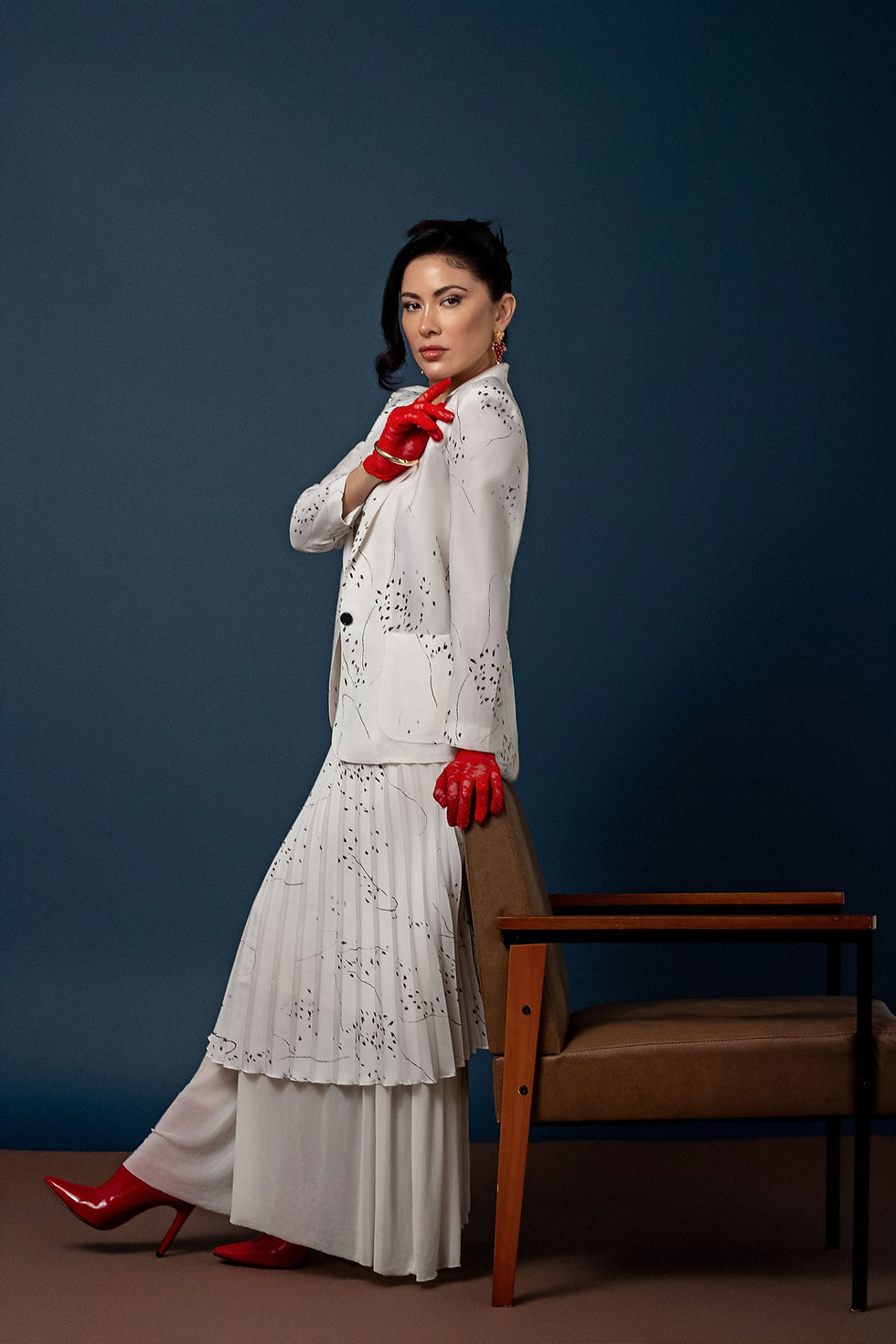
"BUSINESS" EDITION COVER - SEPTEMBER 2026 ISSUE

Nathaly Brandão did not come to facial rejuvenation with a desire to transform faces. What transformed over the years was the way she came to see them.
In her practice, the same situation began to repeat itself. Women would come in pointing to a specific area of their face, convinced that was where the problem lay: more pronounced dark circles, nasolabial folds, a loss of definition. But when looking at the face as a whole, Nathaly realized that the concern was often simply the most visible sign of a change that had begun somewhere else.

It was from this observation, accumulated over years of consultations, that a question emerged—one that ultimately changed the way she approached her work: what if the face could not be treated in parts?
The answer was built through study, practice, and experience. Gradually, it became clear that effective facial rejuvenation required looking at structure, support, proportion, movement, and, above all, the features that are part of each woman’s identity.
From this perspective, the Visage Method was born.
Today, at the helm of a clinic specializing in facial rejuvenation in Sorocaba, her work is particularly focused on women over 40 who recognize the changes brought by aging but do not want to lose the characteristics that make them who they are. For many of them, the desire is not to return to the face they had at another stage of life, but to make their reflection in the mirror better represent who they still are.

It is a difference that changes the way treatment is approached. Instead of starting from an isolated area, the face is understood as a whole, assessing what truly needs to be treated — and, equally important, what does not.
The clinic has grown alongside this vision. Today, the aesthetic biomedical professional also takes on the role of entrepreneur and leader, during a phase of expansion that involves new facilities, a growing team, and a larger clinic.
By her side is her husband, Matheus, who left his previous job to take over the management of the business, turning part of this growth into a family project.

Family plays an important role in this journey. As the mother of Guilherme and Henrique, she has had to balance motherhood, marriage, patient care, studying, and business management without a nanny or a large support network. Reorganizing her schedule to be more present in her sons’ lives has become one of the most meaningful achievements of this phase.
It has also meant learning to share responsibilities. Dr. Paula Toratti, who has worked alongside her for more than five years, has become an important part of the team and of her patients’ journeys, allowing the clinic to grow without losing the sense of closeness that has always been at the heart of her work.

The experience accumulated throughout this journey has also begun to be shared with other professionals through the Método Visage Mentorship. Designed for professionals who already have experience in the field, the program brings together clinical reasoning, consultation approach, patient experience, business management, and professional positioning. Participants are carefully selected, a choice that reflects the desire to preserve the essence of the method even as it expands.
Between the clinic, the mentorship, and new projects, this is a time of professional and business growth. Business recognitions and invitations to events alongside leading professionals in facial harmonization in Brazil have marked this journey, while the new clinic represents the next step in a project that has been years in the making.
There is also a personal dimension to this moment. As she approaches 40, she is beginning to experience some of the changes she sees in her patients every day. She reassesses her own image, reflects on how she wants to age, and understands in a different way the women who come to the clinic simply wanting to recognize themselves again.

Perhaps that is precisely where the essence of her work lies. Not in erasing time or creating a different face, but in preserving a woman’s identity as she cares for her appearance.
After years dedicated to understanding how time transforms the face, she enters a new phase carrying with her a method of her own, a growing clinic, and a unique perspective on the aging process.
The cover of Hooks Magazine arrives at a symbolic moment in this journey. It represents everything that has been built so far, while also marking the beginning of a new chapter for the clinic, Método Visage, and for her as a woman, mother, professional, educator, and entrepreneur.

You built your career at a time when facial aesthetics was largely focused on correcting individual areas of the face: a wrinkle, a fold, a loss of volume. Over time, your work began to take a different path, one much more focused on understanding the face as a whole. Do you remember when you realized that you no longer wanted to simply correct what bothered a patient, but instead understand why it was happening? What changed in the way you saw the face from that point on?
I can’t point to a single day when that realization happened. It was something that began to happen repeatedly in my practice. A patient would point to her nasolabial folds, dark circles, or marionette lines, but when I looked at her entire face, I realized that the area she was pointing to was simply where the signs of aging were most pronounced. It wasn’t necessarily where the problem had begun.
I could treat exactly the area she identified and still fail to restore the lightness she was looking for. In some cases, focusing too much on that particular area could even make the face look heavier. That was when I understood that I needed to stop looking at individual parts and start understanding the face as a whole. The face doesn’t age in isolated compartments. It loses structure, support, contour, and balance as an interconnected system.
From that point on, my consultations changed completely. Before thinking about any procedure, I began to observe how that face was structured, what time had changed, and what still needed to be preserved. The question was no longer, “Where should I add volume?” but rather, “What is making this woman look more tired or older than she feels?”
That was when I began to develop the perspective that would later give rise to Method Visage. A perspective that doesn’t seek to erase the history of a face, but to restore what aging has taken away while preserving identity, expression, and naturalness.

There is a difference between knowing how to perform a procedure and knowing how to read a face. And it seems that the second kind of learning happens much more in front of patients than in a classroom. After so many years in practice, what have women taught you about aging that no course could ever have taught you?
Courses taught me anatomy, technique, safety, and treatment options. But my patients taught me the emotional meaning of a face.
They showed me that aging is not simply about noticing a wrinkle. Often, it is about looking in the mirror and feeling that the reflection no longer represents the woman you feel you are inside. It is constantly being told that you look tired, even when you feel fine. It is avoiding photographs, always looking for your best angle, or realizing that you have lost an expression of lightness that was once part of who you were.
I also learned that most mature women don’t want to have the face they had at 20 again. They don’t want to become someone else. They want to continue recognizing their own features, but with an appearance that feels more rested, cared for, elegant, and aligned with the vitality they still possess.
My patients also taught me that naturalness doesn’t necessarily mean doing less. It means doing what is necessary, in the right amount and in the right places. Sometimes, a very targeted treatment doesn’t create a natural result because it fails to respect the face as a whole.
A more comprehensive and well-distributed treatment plan can look far more subtle than several small, disconnected interventions.
No classroom could ever fully teach me what lies behind the words, “I don’t recognize myself anymore.” I learned that by listening to women. And that listening transformed not only my technique, but also the way I practice my profession.

Method Visage is based on an idea that completely changes the logic of a consultation: often, what a patient wants to treat is not the root cause of what is bothering her. That requires knowledge, but also the courage to challenge an expectation. When did you realize that your role was not to deliver the procedure a patient asked for, but to help her understand what her face truly needed?
I realized this when I understood that performing a procedure correctly was not enough if the indication wasn’t the best one for that particular face.
There is a significant difference between fulfilling a request and taking responsibility for an outcome. When a patient comes to see me, she knows what bothers her, but she isn’t expected to understand anatomy, the causes of aging, or the limitations of each procedure. That responsibility is mine.
That means that, at times, I need to tell her that the procedure she requested isn’t the most appropriate one. I need to explain that treating only that particular area may not resolve her concern or could even make the face look heavier. In other cases, I need to tell her that she doesn’t actually need something she thought she did.
Of course, challenging an expectation can be uncomfortable. It would be much easier to simply provide the procedure she asked for. But I don’t want a patient to leave the clinic simply having had something done. I want her to feel confident that there is a strategy designed for her face, so that the best possible result can be achieved.
That is why the consultation has become one of the most important stages of Method Visage. It is when I listen to the woman, observe her face, and translate what is happening for her. Many patients tell me that they have never received such a thorough explanation of their own face. To me, that is an incredibly valuable moment, because she stops choosing isolated procedures and begins to understand her own aging process.
My job is not to convince a woman to do more. It is to help her make better choices. And sometimes, that also means having the maturity to do less — or to do nothing at all.
For a long time, this perspective existed only in your own hands. Today, it also needs to exist in the hands of other professionals. How do you teach a way of seeing without turning it into nothing more than a technique? And as Método Visage grows, what are the things you refuse to compromise on?
This is perhaps one of the greatest challenges of my journey. A technique can be demonstrated, repeated, and practiced. A trained eye requires experience, observation, clinical reasoning, and sensitivity.
To teach Método Visage, I can’t simply show where or how to perform a particular procedure. I need to teach professionals to understand why they are doing it, what problem they are trying to address, what needs to be preserved, and how each decision affects the face as a whole.
I also teach that a patient cannot be reduced to a before-and-after image. There is a woman behind it, with her own expectations, fears, references, and history with her appearance. Knowing how to listen to her is just as much a part of the method as knowing how to treat her.
That is precisely why I began training professionals within the clinic and also created the Método Visage Mentorship, designed for those who already have experience in the field. The mentorship goes beyond technique. We work on clinical reasoning, consultation approach, patient experience, professional positioning, and follow-up.
I want to train professionals who think, not simply professionals who replicate.
As Método Visage grows, I refuse to compromise on individuality, naturalness, and honesty in treatment recommendations. I don’t want it to become a formula applied in the same way to every face. The method needs to grow without losing the sensitivity that gave rise to it.
I also refuse to compromise on trust. Caring for someone’s face means caring for something deeply connected to that person’s identity. To me, expansion only makes sense if that responsibility remains present in every consultation.

You are approaching 40 while, every day, caring for women who are living through this exact stage of life. At what point do the aesthetic biomedical professional and the woman herself begin to meet in front of the mirror? What has approaching 40 changed in your relationship with beauty, with time, and with the woman you want to continue being?
They begin to meet when what I have observed for years in my patients gradually begins to appear on my own face.
As I approach 40, I am beginning to notice changes that I previously knew mainly through theory and through my work in the clinic. And that gives me an even deeper sense of empathy. I understand what it feels like to look at a photograph and notice something different, even when we still feel young, active, and full of plans.
This stage has also brought greater maturity to my relationship with beauty. Today, beauty, to me, has less to do with perfection and much more to do with presence, identity, and authenticity. I don’t want to freeze time or look like I’m an age I’m not. I want to age while still recognizing myself, preserving my femininity, my expression, and the pleasure I find in caring for myself.
I have also come to see self-care with less guilt. A woman can be mature, a mother, a professional, and a wife, and still want to feel beautiful. That doesn’t make her any less profound. Caring for your appearance doesn’t have to represent a fear of aging. It can represent respect for the woman you have become.
The aesthetic biomedical professional in me helps me understand the process. The woman in me helps me never forget what that process means emotionally. When those two sides come together, my perspective becomes more human. I don’t look only at what has changed in a face. I think about how that woman wants to move through time and who she wants to continue recognizing in the mirror.
I want to end by stepping away from aesthetics for a moment.
After everything you have experienced, studied, and built, is there an idea that has become non-negotiable for you? Something you would like a woman to take with her after hearing this conversation?
There is one idea that has become non-negotiable for me: a woman does not have to choose between accepting time and continuing to care for herself.
For a long time, it seemed as though there were only two paths. Either she fought against every sign of aging, trying to look like someone else, or she had to quietly accept every change in order to prove that she was confident and mature. I don’t believe in either extreme.
It is possible to respect your own history while still wanting to feel more beautiful. It is possible to age without abandoning yourself. It is possible to undergo treatments without erasing your identity. And it is possible to look at yourself in the mirror with greater kindness, without turning beauty into an obligation.
If I could leave every woman with one message, it would be this: time does not take away your right to feel beautiful, feminine, interesting, and alive. You don’t need to go back to who you were at 20. But you also don’t have to give up on recognizing and caring for the woman you have become.
That is what I seek to offer through my work. Not the promise of stopping aging, but the possibility of moving through it with greater awareness, elegance, and freedom.


