Aliati Dermatology: Beauty, Science, and the Art of Caring for Those About to Get Married
- Bridal News

- 2 hours ago
- 10 min read
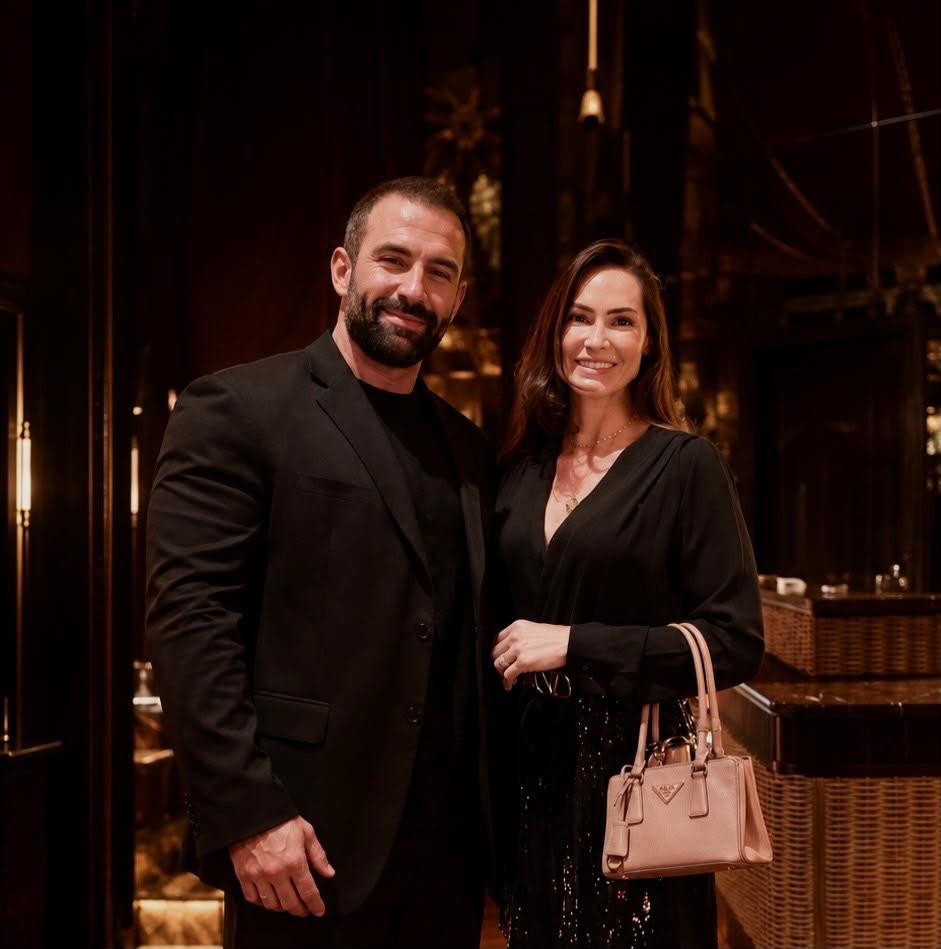
Ana Carolina and Inácio are dermatologists, business partners, and engaged. For those who think this combination requires a strict separation between their professional and personal lives, their answer is straightforward: there is no such division, and that’s perfectly fine.

“We mix the two. We talk about our personal lives here, and we talk about our professional lives at home, because sometimes work is very intense and we have to manage it, taking up some of the free time we have because the demand at the clinic is very high,” Ana Carolina explains. “But we always make sure it doesn’t affect our relationship. When we feel that things are getting too stressful or too heavy, one of us gives the other a heads-up. And then, okay. Now let’s just live our personal lives and stop talking about work.”
She laughs as she recalls how, on the eve of the interview, she had to put an end to the conversation: “I said, okay, it’s 8 p.m. Let’s stop talking about work now, okay?”
From a clinical perspective, the two rarely disagree. “We ask each other for a lot of opinions. And usually, when one gives an opinion, the other agrees. We think very similarly when it comes to clinical, dermatological and aesthetic matters, decisions about patients, and even administrative decisions.” When disagreements do arise, their approach is simple: they respect each other’s decisions. “It’s very rare for us to disagree. And then what? We respect the other person’s decision.”
According to them, what makes everything easier is that they share the same values.
“We have very well-established values, and they really are the same. We think very similarly. That makes it easy to make decisions together.” This consistency extends to their team, which was built with people who share or understand those values. “They also know how to make decisions or solve problems based on our values.”
Inácio adds a perspective that perfectly summarizes their dynamic: “When we have difficult days and need each other’s support, we have that person both at work and at home. The same thing happens at work when difficult situations arise. Complex situations. There’s nothing better than sharing that with your wife, your fiancée, because you completely trust her.”
For them, being a couple and business partners is, above all, an advantage. “The success we’ve had as dermatologists so far is partly because of that, because we are a couple. Because we can work together. We can build together. We move at the same pace, in the same direction, with the same goal.”
Beauty as a Sensitive Subject — Especially When It Comes to Weddings
When the conversation turns to clinical practice, Ana Carolina is careful when explaining how she views beauty. Not as a rule, but as an individual perception that must be respected before any intervention.
“The first thing is that I don’t treat beauty as a rule. Although there is a standard. We study these standards, which naturally create in the unconscious mind of the person looking at them a feeling that a face or body is beautiful. And we know what these standards are. There is the golden ratio, which has already been studied by many thinkers throughout history.” But knowing these standards does not mean applying them indiscriminately. “I don’t like imposing all these standards on patients. So, my goal is, first, to understand what bothers the person.”
This distinction is central to the clinic’s approach. If something does not bother the patient, it does not need to be treated, regardless of what any aesthetic standard might say. “I actually praise it. Wow, your profile is beautiful. The structure of your face is beautiful. I emphasize these things so that the person can also recognize the beautiful features they already have.”
When marriage enters the equation, sensitivity needs to be even greater. “The aesthetic pressure to look your best on your wedding day can be enormous. Sometimes people give opinions about things they shouldn’t even be commenting on.” Ana Carolina observes that many brides arrive carrying old insecurities they had been putting off, and the wedding acts as a trigger. “The wedding clock starts ticking, and they think: I need to do this now because I need to see myself afterward in the photographs. I have to look the way I want to look.”
According to her, the most sensitive issue is not vanity itself, but when the pressure comes from outside. “I see it a lot from the groom toward the bride. And people pressure the groom to have procedures done when the groom doesn’t want to do anything.” At that point, her position is clear: “Groom, is this what you want? Is it your mother? Is it your mother-in-law? Then we’re not going to do anything. Let’s treat the acne because that’s a medical condition. He has to be happy with who he is, and the desire to change also has to come from him.”
The Boom in Aesthetic Procedures — and What Raises Concern
Brazil is currently one of the countries where the most aesthetic procedures are performed worldwide, and this rapid growth has consequences that Ana Carolina observes with concern in her practice.
“We are experiencing an explosion of aesthetic procedures. It used to be the United States. It represented plastic surgery, but now Brazil...” As demand has increased, so has the number of professionals performing these procedures, both medical and non-medical practitioners, and with them, the number of complications. “The less knowledge there is, the greater the risk of complications. This is also well demonstrated scientifically. So, the greater the expertise and the higher the level of training, the lower the risk of complications.”
She frequently sees patients who arrive with complications from procedures performed elsewhere. “I receive many patients who come from other professionals with complications that I first need to address, or sometimes I can’t help the patient as much because the complications are permanent and prevent other treatments. That worries me a little because sometimes we have our hands tied when it comes to helping someone who needs it.”
There is also the problem of new products being launched faster than science can keep up. “I will only use something when there is truly a long-term safety study available. A product may produce a good response, but in the long term, it can cause delayed complications. Sometimes it may not even have approval from Anvisa.” The clinic’s position is firm: safety always comes before results. “Just because a product is showing good results, just because it is a recently launched product, doesn’t mean the procedure is safe.”
To illustrate what can happen when this caution is ignored, Maria Constanza mentions a case that received significant attention in Argentina: a clinic frequented by famous artists that used a concrete-like substance for body procedures. “Extremely famous Argentine artists went to this clinic and went on television saying that they were counting the days of their lives because it is a product you cannot completely remove from your body. It kills. People completely lost sight of what really matters.”
When a Doctor Needs to Say No
There are situations in which the most ethical approach is to refuse a procedure, even if it would technically be possible to perform. Ana Carolina talks about this naturally, as someone who has experienced these situations many times.
“The first principle is do no harm. That is a principle we have in medicine.” There is a condition known as body dysmorphic disorder, in which a patient perceives a defect that objectively does not exist. “In aesthetics, there are many patients who have this medical condition. And if you are ethical, if you are a doctor, it won’t be difficult, deep down, to say no, because you know that you are doing something good for the patient.”
Conversation during the consultation is, for her, the most important tool. “Spending time talking is very important because, through that conversation, we can identify whether something is truly pathological, a medical condition, or whether it is behavioral.” In some cases, she shows patients through photographs and measurements that their facial proportions are balanced and that there is no need for intervention. “The patient says: wow, okay, I understand. And you know that someone who truly understands will pursue other treatments, or will simply continue health follow-up with me, and they stop talking about that issue.”
There was one case in which it was necessary to involve the family.
“It was necessary, in some way, to bring the family into the situation because the patient really needed psychological or psychiatric follow-up. It’s very easy to say yes, very easy. An aesthetic procedure can be extremely tempting for a ‘professional’ who wants to make money at any cost.”
What Brides Need to Know Before Booking a Consultation
For brides considering an aesthetic procedure for the first time because of their wedding, Ana Carolina’s advice begins before they even enter the office.
“The bride needs to look at herself in the mirror, look at herself in photographs, and ask whether what she already has today, on her own, is good enough for her. She needs to understand what truly bothers her and what doesn’t. How does she see herself as a person? How does she see her own image? She should work on what bothers her and not other people, not thinking about how she will look at the wedding. Instead, think about herself as a person today: me, without being a bride. What do I feel? What don’t I like? What makes me a little insecure? What makes me insecure and not other people? I say this to all my patients.”
The second step is to see a dermatologist well in advance. “Often, arriving at a dermatology consultation just two or three months before the wedding is too late to achieve the results the bride wants.” With enough time, it is possible to plan treatments that go far beyond injectables. “Sometimes it’s something as simple as hydrating the skin or improving a particular dark spot. That’s very straightforward. But there are other individual situations that require more time and are not necessarily injectable treatments.”
Inácio adds his perspective as a man who has also begun to see the subject differently since becoming engaged: “As a man, I don’t care much about aesthetic procedures, but seeing photographs from that day is beautiful, and, of course, having a slightly more groomed face. A well-trimmed beard. It makes a difference when you look at those photographs.”
Ana Carolina’s final message is about organization and self-awareness. “Being organized is very important. A wedding is an extremely special moment. It is an entire construction leading up to the wedding day. There is a choice of flowers, music, photographs, videos. Throughout that process, you are building this very special moment. And self-esteem and skin are also important aspects that we need time to prepare for.”
Outside Pressure and the Right to Be Yourself
One of the themes running throughout the conversation was the weight of outside opinions on a bride’s choices, whether aesthetic or otherwise. Maria Constanza, who conducted the interview and is herself a bride and a patient at the clinic, brought up the subject through a personal experience:
“The other day, a bride — and I understand that it was meant with the best intentions — said to me: ‘Oh, Maria, you’re going to lighten your hair, right? You need to lighten it since you want to wear your hair down.’ I said: ‘No, I like my hair exactly the way it is.’”
Ana Carolina recognizes the pattern. “We are constantly bombarded with the words ‘you have to, you need to, you should do, you should have.’ That can become a huge trigger for rushed decisions or decisions based on an insecurity that came from outside and was never necessarily yours.”
Maria Constanza remembers a bride who wanted a half-up hairstyle but was being pressured by everyone around her to wear an updo.
“This girl was extremely distressed, and she wasn’t someone who was very confident about expressing her own opinion. She was allowing herself to be influenced by outside suggestions. At one point, I had to hold her and say: ‘You are the one who is going to see yourself in the photographs. You hate yourself with your hair up — you told me that yourself. Why not wear the half-up style you really want?’”
The bride ultimately got married with her hair half-up, but it was difficult for her to hear until the wedding day that she should have done something different.
“Brides need to have a great deal of emotional resilience, not only to say no or express what they want, but to stand by those opinions.”
Taking Care of Your Skin Beyond Aesthetics: What No One Tells You
When the conversation turns to health rather than just beauty, Ana Carolina becomes even more direct. Skin cancer is the most common cancer in the world, and in Brazil, particularly in the southern region, rates are even higher.
“The essential thing is sun protection. Skin cancer is directly associated with sun exposure. So sun protection means avoiding the strongest sun hours, using sunscreen every day when you are exposed to the sun, and wearing a hat. It is really important, and it works.”
She also recommends an annual dermatology appointment for mole checks and attention to specific signs that may appear over time.
“A mole that starts growing, changes over time, develops a wound, has multiple colors, or becomes darker and looks different from the others. It would be important to seek medical attention early.”
She also warns about the increasingly common habit of following treatment advice from social media.
“I see patients who spend months or years following a treatment their friend recommended or that they saw on TikTok. Then they say, ‘There’s nothing else I can do because I’ve already tried everything.’ When I look at that ‘everything,’ it was everything TikTok told them to do.”
The message, ultimately, is simple: see a doctor before trying to solve the problem yourself.
“Just because it’s a little rash, just because it’s a pimple, that doesn’t mean it’s unimportant or that it isn’t a health issue. So you have to seek help.”
What Is Beauty, After All?
To conclude, the most philosophical question of the interview: what is beauty for someone who dedicates her life to studying and practicing it?
Ana Carolina answers without hesitation, but with the delicacy of someone who knows the answer is not simple.
“Beauty is what makes you feel an emotion when you look at something. And what moves you, what visually brings you a positive emotion, that is beauty.”
But she goes further: it is an individual emotion.
“What brings a positive emotion to me, in my view, is different from what another person feels when looking at the same thing. There are standards of beauty, but real beauty is still about history. It depends on your experiences, it depends on the moment.”
And that is precisely why the perception of beauty can be distorted by a difficult emotional period.
“Emotions are heightened and intensified during engagement. They are constantly being influenced, and we have to try to work through those emotions so that you don’t develop a distorted perception of beauty, which can end up causing harm to yourself because of that perception.”
The most extreme example is a patient experiencing depression who arrives at the office saying she looks horrible, when objectively she looks beautiful.
“The emotion she feels when she looks at herself in the mirror is distorted because of her emotional state and that particular situation. So I can’t simply recommend a procedure for every complaint she brings to me, because otherwise I would be pushing her even further down that path and causing harm.”
It was at this point that Maria Constanza ended the conversation with an observation that made everyone smile: Inácio had said that beauty is what evokes emotions and that, to him, Ana Carolina is always beautiful, even in the moments when she says she looks horrible.
“How wonderful that he is the person you are going to marry. Isn’t that what we want for life? A partner who loves us at every moment.”
Ana Carolina added, with a smile: “That we evoke emotions.”
And the interviewer laughed: “That’s a line for your wedding vows, everyone. That’s a line for the vows.”